Category: Opinion

  • Opinion: Borrowing from Monticello

    Opinion: Borrowing from Monticello

    Recently, an anonymous letter circulated questioning an essay I published in April, before announcing my candidacy for the Board of Supervisors. Since it has been brought up, I’d like to address it directly.

    First, the missing article. The Appomattox Times website was migrated to a new platform this summer. In the process, several older articles, including that essay, were mistakenly left on the old server. This has since been corrected. There was no attempt to hide anything. In fact, I published it openly under my own name, months before I was a candidate.

    Second, the “wealthy landowner” charge. Every property I own is right here in Appomattox County. My current residence and two rentals in town and twenty acres in Hixburg, all mortgaged, purchased with hard-earned dollars, and on the tax rolls. Nothing was inherited. I’ve invested here because I believe in this county’s future.

    As for the essay itself, I stand by its spirit. I was writing as a new father about the burden one generation can place on the next. Thomas Jefferson wrote to James Madison in 1789: “The earth belongs to the living, not to the dead. No man can, by natural right, oblige the lands he occupied… to the payment of debts contracted by him.” Jefferson’s point was clear: one generation has no natural right to eat up the substance of those who follow. Yet this past April, Washington passed a budget that will add $5 trillion to the national debt. My point was simple: if Congress will not think of our children, then at least here at home, we must.

    That was an essay, not a policy proposal before the town. My record on council speaks to what I’ve fought for: water, sewer, trash, and economic development. Check the minutes, check the votes, check the statements: you will see I’ve been leading on the very issues our town needs solved first.

    Anonymous letters can throw around labels like “socialist.” But Jefferson was no socialist, he was the first Virginian to warn that generational debt robs the future. That is the tradition I am standing in, and that is the standard I will continue to uphold.

    Nathan A. Simpson

  • Second Opinion: Appomattox’s Future Depends on How We Treat Our Schools and Our Teachers

    Second Opinion: Appomattox’s Future Depends on How We Treat Our Schools and Our Teachers

    Appomattox’s ability to thrive in the years ahead depends on how much we are willing to support and invest in our public schools, through funding, engagement, and sustained attention, beginning today. 

    I am both a parent and someone who’s spent years pursuing higher education. I know from experience that children’s futures are shaped not just by what happens at home, but by what happens every day in their classrooms. I see the dedication of our teachers and staff, the excitement (and sometimes anxiety) on students’ faces as they head off to school, and the way a good education can open doors to a lifetime of opportunity. 

    But I also see the challenges, some of which can’t be ignored any longer. The truth is that our schools are under real pressure. One building operates at over 100% of its student capacity. Others are operating at over 90% capacity, with more students arriving every year. The county wisely approved $1.13 million for much-needed repairs and upgrades, but bricks and mortar are only part of the story. What about the people inside? 

    Let’s talk honestly: Teachers are being asked to do more with less. When enrollment goes up and resources don’t keep pace, it’s not just an inconvenience. It’s a recipe for teacher burnout and student frustration. I know teachers who spend their own money on classroom supplies, who take work home night after night, and who worry constantly about reaching every child in their care. I have seen, firsthand, the impact a caring, well-supported teacher can have on a student, and I have also seen the toll it takes when teachers are stretched thin. 

    The county’s FY 2025 school budget is $37.14 million. On paper, that looks like a lot. But when you break it down to cover staffing, transportation, technology, facility maintenance, extracurriculars, and rising costs for everything from textbooks to electricity, it becomes clear just how tight things can get. Last year, Appomattox schools nearly lost $800,000 in state funding simply because a $300,000 local match couldn’t be secured. These are not just numbers, these are lost opportunities for our kids. 

    What does all of this mean for families? It means we risk larger class sizes, fewer programs, and teachers leaving the profession altogether. That is a future none of us want. Our children deserve better, and so do the teachers who give so much of themselves every day. 

    This is not about finger-pointing or politics. It’s about priorities. Are we willing to step up, not just in moments of crisis, but year after year to make sure Appomattox is a place where families want to stay, teachers want to teach, and students want to learn? I believe we can and should. 

     
    If we want a strong, thriving future for Appomattox, we must invest in our public schools and the people who make them great. That means more than the occasional budget boost or facility fix. It means committing to adequate funding, hiring enough staff to reduce overcrowding, supporting professional development, and giving teachers the respect and compensation they deserve. 

    Let’s make Appomattox known for more than its past. Let’s build a future where every child leaves our schools prepared, confident, and proud of where they come from. That future starts with us, and it starts right now. 

  • Opinion | We Can’t Live on History Alone—Appomattox Needs a Future Too

    Opinion | We Can’t Live on History Alone—Appomattox Needs a Future Too

    Appomattox is a town built on history, from the fields where the Civil War ended, to the little shops and family-run businesses that have kept the town going for generations. The town has always been about resilience; about community and showing up for each other.

    There was a time when this town thrived. Agriculture, railroads, tobacco, tourism; they each had their moment., and through it all, Appomattox stood strong. The town where Lee surrendered to Grant. The place where a war ended, and healing began. That history is something to be proud of.

    But history alone won’t carry the town forward, and as the world around us keeps shifting, from coal to code, from farming to fiber optics, the town is at a crossroads. Other small towns are changing, adapting, finding ways to grow. If not careful, Appomattox will get left behind.

    Right now, the median household income here is about $58,000, which is lower than both the state and national averages. That number isn’t just data, it’s a sign that people are working hard, but not always getting ahead. And the next generation? They’re leaving. Not because they don’t love this place, but because they don’t see a future in it. And honestly, who could blame them?

    We can’t keep repeating the same pattern; empty buildings, low-wage jobs, another dollar store we didn’t ask for. What we need are businesses that attract, not distract. Places that spark energy, offer real jobs, and bring something new to the table. Tech startups, clean energy companies, more local businesses. Grocery stores like Trader Joe’s or Whole Foods that value wellness and community. We need options that make people want to stay, and make new folks want to come.

    Because let’s be honest, Gen Z isn’t looking for parking lots and strip malls. They want a walkable downtown with fast Wi-Fi, green spaces. organic food and most of all a sense of purpose. They’re building lives around value and experience, not just convenience.

    So why not give them a reason to choose us?

    Picture it: a downtown full of life co-working hubs for remote workers, live music on the weekends, food trucks lining the square, art festivals and open-air concerts that bring people together. Imagine the local history coming alive through reenactments, interactive exhibits, and festivals that not only educate, but inspire. Kids laughing in community gardens. Artists finding space to create. Visitors staying the night, not just passing through. In the end the town and the people in the town prosper.

    We don’t have to erase the towns roots; we just need to let them grow. Appomattox already has the story. Let’s tell it louder, bolder, and with a vision for the next chapter. Because here’s the truth: if we don’t act or invest in our people, Appomattox could slowly slip into being just another ghost town. A memory, instead of a destination. Why continue letting Lynchburg, Farmville and Richmond take our revenue, let’s make it a town to work and shop in.

    I didn’t grow up here. But I chose this town. The pride, the grit and the possibility. Let’s stop waiting for change to find us. Let’s build something that ensure the stability of the town for future generations.

  • Opinion: A County-Level Rebalance: Three Ideas for a Generation Left Behind

    I think it’s time we talk about generational imbalance, particularly in how our government allocates resources and political influence. If we’re serious about keeping communities alive for the long haul, we need bold local action. Not just federal rhetoric.

    Here’s what I propose, at the county level:

    • We eliminate property taxes for anyone under 40 earning less than $100,000 a year.
      • We provide heavily subsidized (free) daycare for working parents.
      • And we restrict housing incentives: grants, tax abatements, or low-interest loans, for people under 40 who are buying single-family homes.

      All three of these ideas are local. We don’t need to wait for Congress. Counties control property taxes, zoning, childcare grants, and local incentive structures. This is about political will. The hard truth is that young people don’t vote at the same rate as older generations, and so their interests are not equally represented. This is the root of the problem.

      We live in a country where retirees vote in droves, and their lifestyle has been heavily subsidized, often by borrowing from the very people who can no longer afford a home or daycare. The numbers don’t lie: we are not a rich enough society to support non-wealthy, non-working adults living alone, indefinitely. We’re simply not. And we haven’t been for a while.

      Instead, we need to embrace multi-generational housing, not as a step backward, but as a return to interdependence. That requires families to get along, yes. But more than that, it requires acknowledging a painful truth: one generation handed off a country with rusted-out infrastructure, the long tail of globalism, a student debt crisis, and inflated asset prices. Saying “I wasn’t in charge” doesn’t cut it anymore. You didn’t need to be a billionaire to benefit. Americans of a certain generation got a better deal, cheap college, affordable housing, stable pensions, and many voted to keep it that way, even as it disappeared for others. A lack of wealth in retirement doesn’t absolve someone of having supported or profited from a system that burdened those who came after.

      I used to be quieter about all this. More “go along to get along.” But after my daughter Vienna was born, something shifted in me. The stakes feel clearer now. Generational responsibility flows in both directions, and I want Vienna to inherit a world where that burden is shared fairly. Of course I don’t want older people to suffer. I’d love for everyone to afford dignified care until the very end. But we can’t build a society on what we wish we could afford. We have to build on what we can.

      My fear is that Gen X, squeezed in the middle, will be blamed for a crisis that began before them and worsened under them. And while blame is easy, it doesn’t help. What helps is naming the problem, suggesting local solutions, and getting more young people to see themselves as political actors with power, if they use it.

      I don’t write this to provoke. I write it because I care. Because I think there’s still time to realign our local priorities. And because if we don’t start soon, Vienna and her generation will be paying off debts: economic, social, and environmental, that they never agreed to take on.

    1. New Sculpture on Main Street: “The Limits of the State” and the Art of Speaking (or Not Speaking) Freely

      New Sculpture on Main Street: “The Limits of the State” and the Art of Speaking (or Not Speaking) Freely

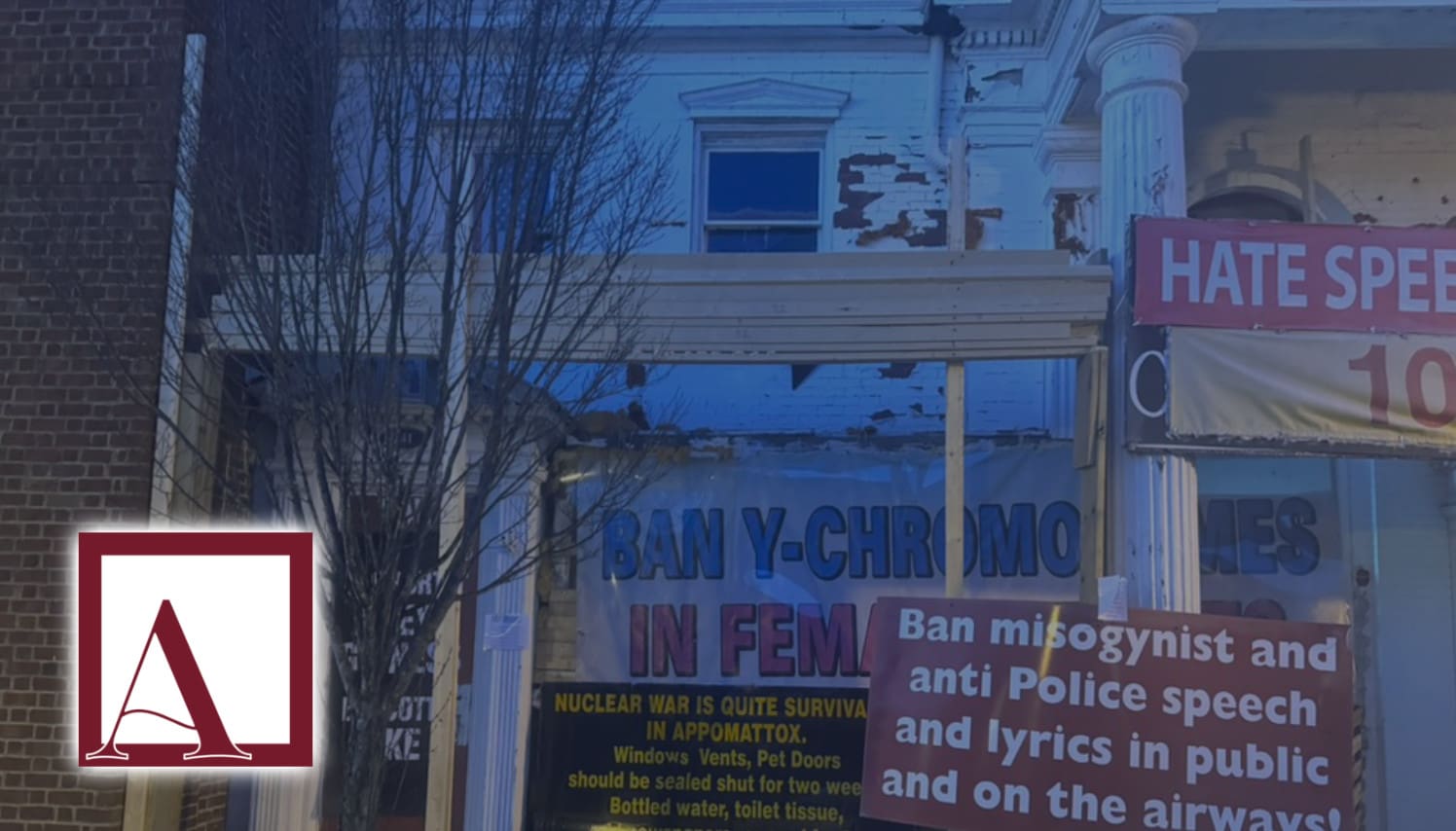
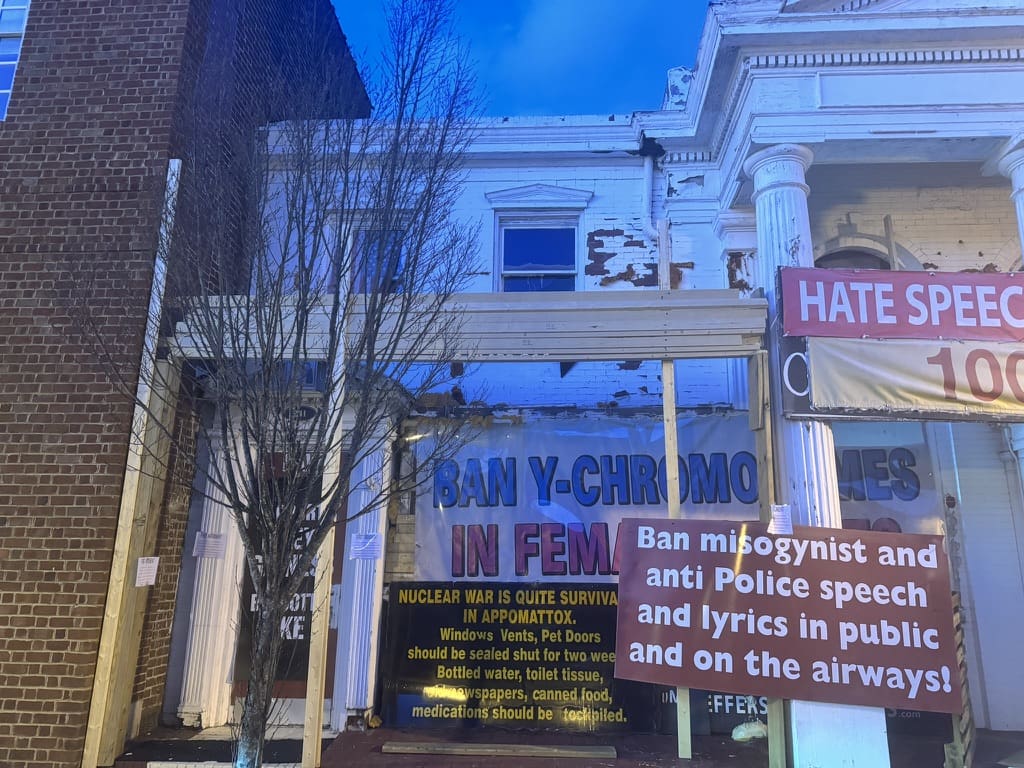
      APPOMATTOX—There is a kind of tenuous grandeur to the scaffolding of democracy, and nowhere is this made more literal than in The Limits of the State (2025), a mixed-media installation currently displayed on a storefront in downtown Appomattox. Constructed from humble materials—#2 pine, Portland cement, and hex-drive tapcons—this piece speaks not only to the structural fragility of free expression but to the forces that seek to encase, reinforce, and, at times, erase it entirely.

      At first glance, one might mistake The Limits of the State for an act of emergency renovation, the haphazard bracing of something coming apart at the seams. But step closer. Notice the thirteen wooden beams, a deliberate invocation of the thirteen original colonies, now repurposed not as a foundation of freedom but as a barricade. These slats of wood, hastily joined and industrially fastened, stand in as both sentinels and jailers—protecting what remains, enclosing what cannot escape.

      It is in this setting that we see the quiet tragedy of a single laminated sheet of copy paper, bearing the First Amendment, almost invisible against the more assertive proclamations of authority. Just inches away, a imposing red banner commands:

      “Ban misogynist and anti-police speech and lyrics in public and on the airwaves!”

      The contrast is stark: the most foundational liberty in American life, printed in the size of a lunch menu, is rendered a whisper against the roaring decree of censorship. The piece forces us to ask: What is the role of free speech in an era of compelled silence? Where do the boundaries lie between protection and prohibition, between public safety and the policing of thought?

      And then, the deeper question lingers—a reference to that enduring legal metaphor, the proverbial ‘crowded theater.’ Has the artist presented us with a crisis of irresponsible speech or a society too willing to bar the exits before a word has even been uttered?

      The genius of The Limits of the State lies in its incompleteness, its refusal to provide an answer. It is at once a work of warning and inevitability, a portrait of a nation eternally caught between its loftiest ideals and its basest instincts. It does not demand a verdict, only attention.

      If we listen closely, perhaps we can still hear the echoes of what was once allowed to be said.

    2. When Leadership Meant Wearing Many Hats: Alfred Rice Harwood and the Foundations of Modern Appomattox

      When Leadership Meant Wearing Many Hats: Alfred Rice Harwood and the Foundations of Modern Appomattox

      A Legacy of Building, Service, and Community Trust

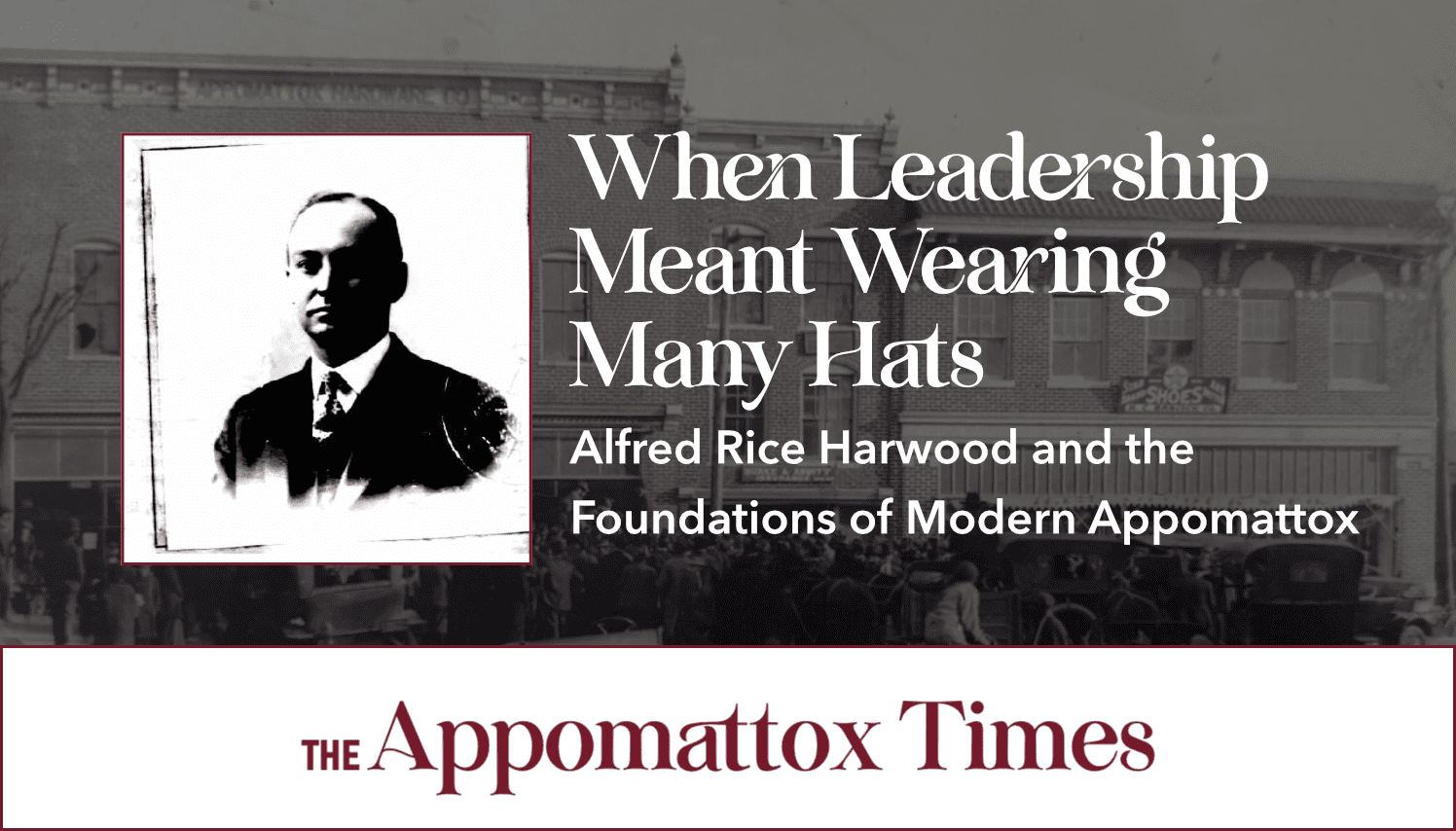
      When we consider the life and contributions of Alfred Rice Harwood (1880–1951), we see far more than a simple catalog of job titles and achievements. We see a portrait of a man who personified the civic-minded entrepreneurial spirit of early 20th-century America. Appomattox County was changing rapidly, inching its way out of an agrarian past and into a new century defined by railroads, automobiles, and the promise of broader markets. In this environment, leaders like Harwood stepped forward—blending business acumen, public service, and a deep personal commitment to improving their communities.

      The Early 1900s: An Age of Builders and Doers

      Between 1900 and the start of World War I, the United States underwent a period of intense economic growth and innovation. Electricity, telephones, automobiles, and new forms of mass communication began knitting the country closer together. In smaller towns especially, “progress” arrived hand in hand with local entrepreneurs who organized banks, built water systems, expanded postal services, and founded essential businesses. In Appomattox, Alfred Rice Harwood was at the forefront of this wave—his work laying much of the groundwork for modern infrastructure.

      Founding a Bank, Leading the Community
      When Harwood organized The Farmers National Bank in 1917, his role as the bank’s first and long-serving “cashier” was akin to that of a chief operating officer today. In the early 20th century, the word “cashier” described an officer responsible for day-to-day operations, lending decisions, and balancing the bank’s books. The position was as prestigious as it was critical: a local bank officer could make or break new businesses, decide whether farms had funding for spring planting, and ultimately help shape the town’s economic destiny. The trust placed in someone like Harwood was enormous, and that trust was reciprocated through the bank’s success and stability.

      Postmaster as a Key Community Builder
      Harwood’s tenure as Postmaster after 1931 came in an era when local post offices were more than just distribution centers. They were hubs of daily life and vital communication links for both government services and private citizens. Because he was chosen to fill the position when the incumbent unexpectedly passed away, it suggests how respected he was in official circles. His appointment was more than simply a paycheck; it was a civic trust, an expectation that he would bring integrity and efficiency to a role that many saw as indispensable to a thriving town. Under his stewardship, the Appomattox Post Office reached First Class status—a milestone that validated both the town’s growth and Harwood’s personal dedication to serving the public.

      Changing Conceptions of Power and Prestige

      Looking back, the array of roles Harwood held—cashier, postmaster, hardware store founder, oil distributor, life insurance agent, sawmill operator, real estate broker—might make modern observers wonder about conflicts of interest. How could one individual wear so many hats without raising eyebrows?

      Yet in small-town America of the early 20th century, that blend of public service and private enterprise was not only common but highly valued. A trusted businessperson with a reputation for honesty was naturally called upon to guide other civic and economic institutions. People wanted to see those they already trusted in positions of influence—especially in places where infrastructure was scarce and progress hinged on a few energetic individuals.

      Today, we often view such overlapping roles with caution. Modern regulations and cultural norms place a higher priority on preventing conflicts of interest. Federal laws and professional oversight groups scrutinize relationships between government, business, and community entities. That transformation is a testament to how society has grown more complex, with more stakeholders and regulatory frameworks.

      In Alfred Rice Harwood’s world, however, the lines were deliberately blurred. A single person’s success often benefitted the entire town—indeed, a “rising tide lifts all boats” mindset was both an economic reality and a moral expectation. When the man who owned the hardware store also ran the bank and then improved the local water system, no one questioned his motives; they saw tangible improvements in daily life. To suggest impropriety or call for his resignation would have been puzzling or even offensive to many contemporaries. His many ventures provided practical solutions that propelled the county toward modernization.

      Then and Now: Two Eras of Sweeping Change

      We live in a time often compared to the “Roaring Twenties,” with technological leaps in digital communication, artificial intelligence, renewable energy, and global connectivity. Just as Harwood and his generation embraced the motorcar, electrification, and rapidly developing manufacturing techniques, we face similar seismic shifts. In both eras:

      1. Innovation Outpaces Regulation
        • Early 1900s: The automobile, new machinery, and centralized banking systems flourished before widespread regulatory frameworks were in place.
        • Present Day: Online marketplaces, cryptocurrency, telemedicine, and AI disrupt traditional industries faster than governments can pass regulations.
      2. Infrastructure as a Keystone of Progress
        • Early 20th Century: Water systems, roads, and postal routes changed how people lived and worked, helping to unify communities.
        • Today: Broadband internet, smart grids, and sustainable energy networks are viewed as essential for ensuring economic growth and global competitiveness. And, in the case of Appomattox, water and sewer are just as relevant now as they were at the turn of the previous century.
      3. Social Transformations
        • Early 1900s: The era saw major migrations from rural to urban areas, changing labor markets, and new consumer cultures spurred by mass production.
        • Now: Digital platforms allow remote work, global talent pools, and the emergence of new social norms around information sharing, data privacy, and work-life balance.

      In both settings, the call to action for community leaders has remained strikingly similar: “Step up, build something useful, and unite the people around common goals.” Harwood’s life story reminds us that true progress often requires visionaries willing to wear multiple hats—who see no contradiction in being a banker, a builder, a postmaster, and a pillar of church and civic life. Though in the 21st century we might use different terminology and governance structures to ensure fairness, the basic principle endures: communities flourish when capable, ethical individuals bring their talents to bear across many domains.

      A Remarkable Man for a Remarkable Time

      Alfred Rice Harwood’s obituary recounts decades of momentum-building for Appomattox County. Each new venture—from his hardware store to the local Ford dealership, the water system acquisition and improvement, and finally the First Class Post Office—was a sign of a leader who refused to settle. His energy and foresight matched the tempo of an America eager to harness fresh opportunities. Though his era has long since passed, his example of resourceful leadership, community trust, and moral commitment remains profoundly relevant.

      The early 20th century’s heyday of bold expansion resonates strongly with our modern drive for revitalization and transformation. Harwood’s life underscores a timeless lesson: when public-minded entrepreneurs step forward with integrity, they can reshape an entire region—and leave behind a legacy that inspires future generations to find their own ways of elevating and uniting a community.

      In memoriam, Alfred Rice Harwood (1880–1951).

      May we remember not only the roles he filled, but also the spirit in which he filled them. His work helped bridge the gap between a rural, agrarian past and a connected, forward-looking future—lessons that continue to guide us as we face our own century’s promise and perils.